
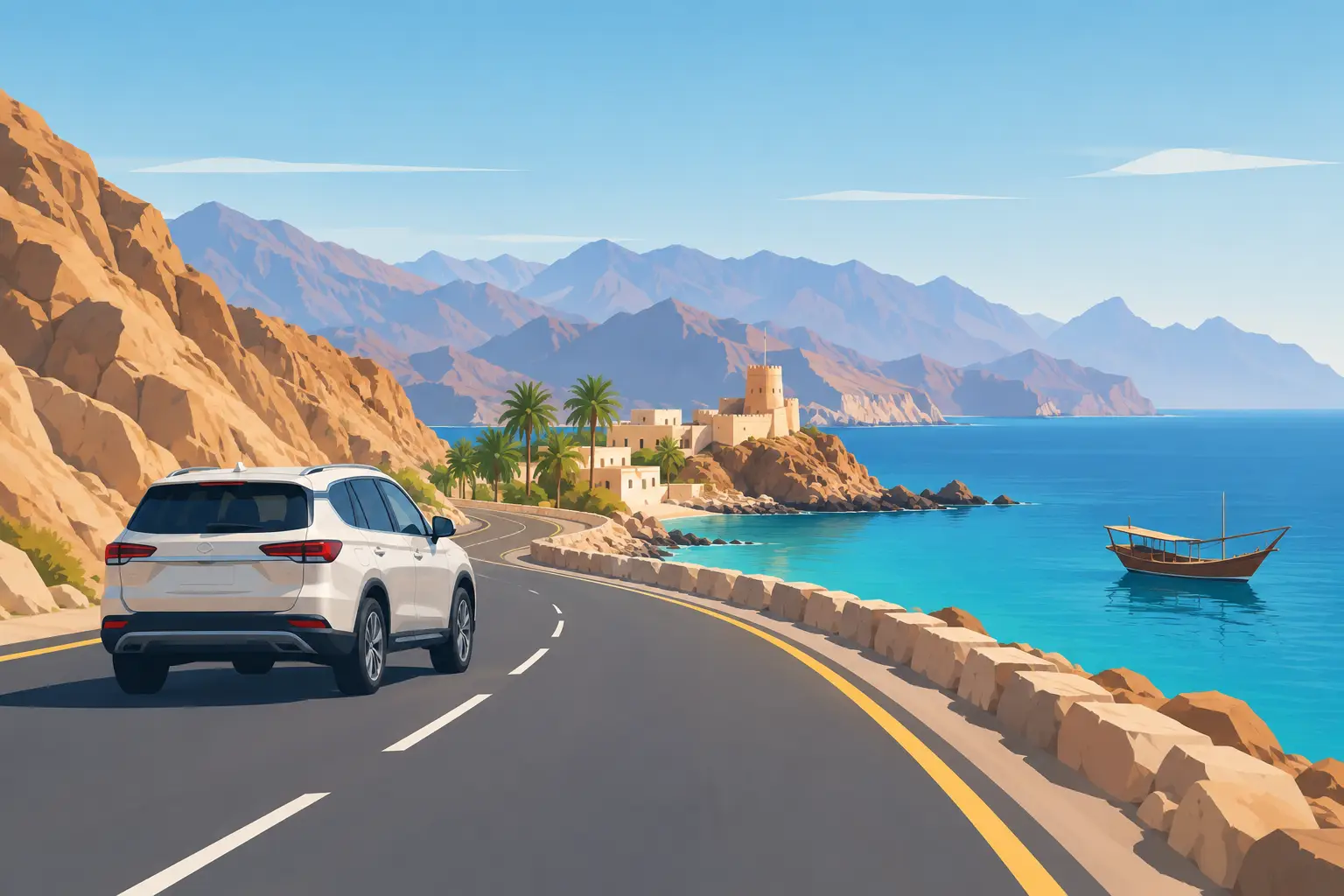
The road from Muscat toward the Hajar Mountains changes quickly: whitewashed towns give way to rocky valleys, date palms, and high passes. That contrast is exactly what makes an Oman self drive itinerary so rewarding. In one week, you can swim beneath canyon walls, sleep beside desert dunes, walk through old mud-brick villages, and watch the sun fade over the Gulf of Oman.
This route is designed for travelers who want independence without spending every evening working out the next day’s drive. It balances Oman’s landmark experiences with realistic travel times, comfortable overnight stops, and a few moments to slow down. A 4WD is strongly recommended, particularly for the desert and mountain sections.
Day 1: Muscat – Coast, Culture, and a Gentle Start
Arrive in Muscat, collect your vehicle, and resist the temptation to pack too much into your first day. Oman’s capital is spread along the coast, with the mountains rising behind its white buildings, so it is best experienced in a few focused stops rather than rushed sightseeing.
Begin with the Sultan Qaboos Grand Mosque if your arrival timing allows. Its architecture, gardens, and vast prayer hall offer a memorable introduction to the country’s care for craftsmanship and hospitality. Dress modestly, and check visiting hours in advance, as access for non-Muslims is limited to specific times.
Later, drive to Mutrah Corniche. Walk beside the harbor, browse the souq for frankincense and silver, then continue toward Old Muscat for views of the ceremonial palace and Portuguese-era forts from the outside. End your first evening with fresh seafood along the waterfront or a quiet dinner at your hotel.
Stay in Muscat. Keeping this first day simple makes the rest of the journey more enjoyable.
Day 2: Muscat to Wadi Shab and Sur
Leave Muscat early for the coastal drive southeast toward Wadi Shab. The journey follows a dramatic route where bare mountains meet the turquoise Arabian Sea. It is one of Oman’s most beautiful road trips, but it is also popular, so an early departure means cooler temperatures and more space on the trails.
At Wadi Shab, a short boat crossing leads to a walk through the canyon. Wear shoes that can handle uneven rocks and water. The route includes pools and narrow passages, and reaching the hidden cave and waterfall involves swimming. It is an adventure, not a quick roadside stop, so allow several hours and bring drinking water in a dry bag.
Continue to Sur in the afternoon. This traditional coastal city has long been associated with dhow building, and a visit to the dhow yard gives the day a cultural dimension after the wadi. Spend the night in Sur or nearby Ras Al Jinz. Between May and September, the coast can be especially humid, so air-conditioned accommodation is welcome.
Day 3: Sur to Wahiba Sands
Start the morning with a look at Sur’s quiet waterfront before heading inland toward Wahiba Sands, also known as Sharqiya Sands. The scenery changes from coastal plains to open desert, with the first copper-colored dunes appearing on the horizon.
This is where vehicle choice matters. Reaching a desert camp usually requires driving on soft sand, and a standard sedan is not suitable beyond the paved approach roads. If you are confident with off-road driving, reduce tire pressure at a proper service point and follow an established route. If not, arrange a local desert transfer from the edge of the dunes. It is a smart trade-off: you still enjoy the desert, without turning a vacation into a recovery mission for a stuck vehicle.
A night in the desert is one of the defining experiences of an Oman self drive itinerary. Ride over the dunes near sunset, try sandboarding, share an Omani-style dinner, and look up after dark. Away from city lights, the stars feel close enough to reshape the whole sky.
Day 4: Wahiba Sands to Nizwa
Watch the sunrise over the dunes, then leave the desert before the heat builds. Your destination is Nizwa, one of Oman’s most historic cities and an excellent base for exploring the interior.
The drive is generally straightforward, though it takes time, especially if you pause in small towns or photograph the changing terrain. Arrive in Nizwa with enough daylight to settle in and walk around the old center. The fort is the city’s essential landmark, recognized by its massive circular tower and views across palms, mosques, and mountains.
If your schedule falls on a Friday morning, Nizwa’s livestock market is a vivid local tradition. It is fascinating but busy, and it should be approached respectfully. On other days, the souq is a more relaxed place to browse pottery, dates, spices, and the khanjars, the curved daggers that are an important symbol of Omani heritage.
Stay two nights in or near Nizwa. This avoids unnecessary repacking and gives you time to explore the surrounding highlands.
Day 5: Nizwa, Bahla, Jabrin, and Misfat Al Abriyeen
Use this day for Oman’s fortified heartland. Begin at Bahla, where the vast fort and old mud-brick settlement reveal a different side of the country’s history. The scale of the walls is striking, especially against the dry mountains beyond the town.
Continue to Jabrin Castle, known for its decorative ceilings, carved wooden doors, and rooms that feel more intimate than a military fort. The two sites complement each other: Bahla is monumental and atmospheric, while Jabrin offers a close look at royal life, education, and traditional architecture.
In the afternoon, head toward Misfat Al Abriyeen, a hillside village of stone houses, terraced gardens, and falaj irrigation channels. Walk quietly through the lanes and keep to marked paths. This is a lived-in community, not an open-air museum, and that is part of its charm.
Return to Nizwa for the night, or choose a heritage-style stay near Misfat if you prefer a slower rural evening.
Day 6: Nizwa to Jebel Shams or Jebel Akhdar
Today calls for a choice, because Oman’s two best-known mountain regions offer different experiences.
Jebel Shams is the choice for canyon views and big, rugged landscapes. The Balcony Walk near Al Khateem follows the rim of Wadi Ghul, often called the Grand Canyon of Oman. The trail is spectacular but exposed, so start early, wear proper walking shoes, and do not attempt it in poor weather.
Jebel Akhdar is greener, cooler, and more village-focused. Its terraced farms are especially beautiful during the rose season in spring, while cliffside viewpoints and small mountain communities make it ideal for travelers who prefer scenic drives and shorter walks. Access to Jebel Akhdar requires a 4WD at the checkpoint.
Whichever mountain you choose, avoid driving unfamiliar tracks after dark. Roads can be steep, unlit, and affected by rain. Spend the night in the mountains, where the cooler air is a welcome contrast to the coast and desert.
Day 7: Mountain Roads Back to Muscat
Leave the mountains after breakfast and return to Muscat. The driving time varies depending on your overnight location, but the descent itself is part of the experience. Stop for coffee, take in the views one last time, and allow extra time for fuel and vehicle return procedures.
If your flight is later in the day, add a final stop at the Royal Opera House area, Qurum Beach, or one of Muscat’s small museums. If you have an early departure, return the car the evening before and arrange an airport transfer for a calmer final morning.
Practical Advice for Self-Driving in Oman
Oman is one of the Gulf’s most approachable destinations for road trips. Main roads are well maintained, signage is generally clear, and driving is on the right. Still, distances can be deceptive on a map. Build in time for photo stops, mountain curves, and the occasional herd of goats crossing the road.
A 2WD vehicle works well for Muscat, Nizwa, Sur, and most paved routes. Choose a 4WD if your plan includes Wahiba Sands, Jebel Akhdar, remote mountain roads, or wadi access tracks. Never drive into a wadi during rain or when water is flowing strongly upstream. Flash floods can arrive with little warning, even when the sky above you is clear.
Carry more water than you expect to need, keep your fuel level comfortably above empty outside major towns, and download offline maps before heading into the mountains or desert. Modest clothing is appreciated in villages and public places, while swimwear is best reserved for beaches, pools, and designated wadi swimming areas.
For travelers who want the freedom of the road with local planning behind them, Majan Views Tourism can organize the vehicle, accommodations, desert logistics, and guided experiences around the parts of Oman that deserve more than a quick stop.
The best self-drive trips in Oman leave room for the unexpected: a roadside fruit stall, a mountain village at golden hour, or a quiet beach with no one else in sight. Keep the route flexible enough to stop when Oman asks you to.

Comment (0)