
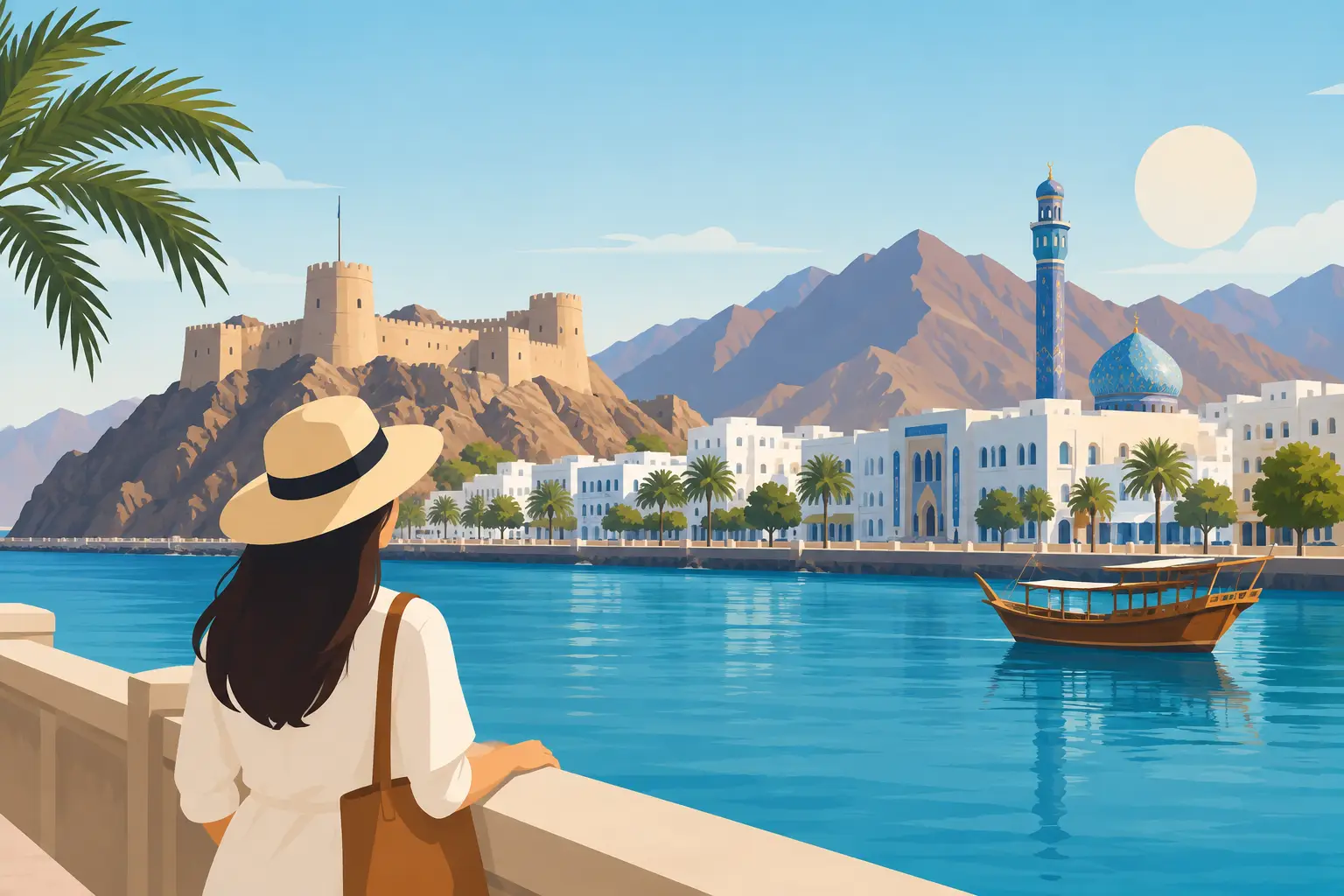
Muscat rewards travelers who slow down, even when time is short. If you are wondering what to see in Muscat in one day, the answer is not to race from landmark to landmark. Build your day around the city’s natural rhythm: a grand mosque in the morning, the scent and color of Mutrah at midday, Old Muscat’s ceremonial heart in the afternoon, and the sea at sunset.
Muscat stretches along the Gulf of Oman, with rugged mountains rising directly behind its white buildings. Distances can look short on a map but take time in traffic, especially around business hours. A private driver or guided excursion makes a real difference for a one-day visit, leaving you free to enjoy the views rather than navigate routes, parking, and opening times.
What to see in Muscat in one day: the best route
Start early at the Sultan Qaboos Grand Mosque, then travel toward Mutrah and Old Muscat. This creates a logical west-to-east route and keeps the day focused on the places that reveal Oman’s architecture, maritime heritage, royal history, and everyday hospitality.
If your flight arrives late morning or you are visiting on a day when the mosque is not open to non-Muslim visitors, adjust the route rather than trying to force every stop in. Muscat is best enjoyed with time for a traditional coffee, a few unplanned photographs, and a conversation with a shopkeeper.
Morning: Sultan Qaboos Grand Mosque
Begin with one of the country’s most impressive landmarks. The Sultan Qaboos Grand Mosque is a striking introduction to modern Oman, built in warm sandstone and surrounded by immaculate gardens, arcades, and geometric detail. Its calm atmosphere is part of the experience, so arrive at opening time when the courtyards are cooler and quieter.
Inside the main prayer hall, look up at the vast chandelier and down at the handwoven Persian carpet. The scale is remarkable, yet the design never feels excessive. Every carved panel, tile pattern, and arch reflects the craftsmanship that defines Oman’s public architecture.
Dress respectfully: shoulders, knees, and legs should be covered, while women should cover their hair. Opening hours for visitors can change, and access is usually limited to morning hours on specific days, so it is worth confirming before setting out. A licensed Omani guide can add the cultural context that makes the visit more meaningful, from Islamic architectural traditions to the mosque’s role in contemporary Oman.
Late morning: Mutrah Corniche and Souq
From the mosque, head toward Mutrah, the historic port district where Muscat’s mountains meet the sea. The drive itself gives you a sense of the city’s shape: long coastal roads, low-rise neighborhoods, mosques, and rocky ridges appearing between the buildings.
Walk the Mutrah Corniche before the afternoon heat builds. Fishing boats and traditional wooden dhows move across the harbor, while the waterfront curves toward the old trading quarter. This is one of the best places to feel Muscat’s maritime character. For centuries, ships carrying frankincense, dates, textiles, and spices connected this coast with East Africa, India, and beyond.
Then enter Mutrah Souq through its covered lanes. It is more atmospheric than polished, with the sweet smoke of frankincense in the air and stalls piled with silver jewelry, embroidered caps, scarves, brass coffee pots, spices, and Omani perfumes. The souq is not a museum, so expect a lively mix of visitors, families, and local shoppers.
Take your time here, but shop with a little strategy. Frankincense and small handicrafts are easy souvenirs to carry, while antique-style daggers, silver pieces, and textiles deserve closer inspection. Bargaining is generally polite and measured. A friendly greeting and genuine interest go further than aggressive negotiation.
Lunch: choose Omani flavors over a rushed meal
For lunch, stay near Mutrah or move toward Old Muscat. A one-day itinerary is not the moment for a long detour to a resort restaurant. Choose a local meal with grilled fish, chicken shuwa-style dishes, rice, fresh bread, and dates, or stop for karak tea and a light snack if you prefer an earlier dinner.
Omani food is generous without being overly complicated, often balancing fragrant rice, slow-cooked meat, cardamom, saffron, lime, and spice. If you travel with children or have dietary requirements, Muscat has plenty of flexible options, but tell your driver or guide in advance so the stop fits your day.
Afternoon: Old Muscat, Al Alam Palace, and the forts
Continue to Old Muscat, the ceremonial center of the capital. The scenery changes quickly here. Mountains close in around the road, white government buildings sit beneath rocky cliffs, and the city feels more formal and secluded than Mutrah.
The Al Alam Palace, recognizable by its blue-and-gold façade, is the ceremonial palace of the Sultan. Visitors cannot enter the building, but the exterior and surrounding square make a worthwhile stop. This is less about a lengthy visit and more about taking in the setting: the palace framed by mountains, sea, and historic fortifications.
On either side stand Al Jalali and Al Mirani forts, built during the Portuguese presence in the 16th century. They are not generally open for casual interior visits, but their dramatic position above the harbor tells an important part of Muscat’s story. From the road and surrounding viewpoints, you can see why this protected cove was so valuable to seafarers and rulers alike.
If you have a strong interest in history and your timing works, add the National Museum nearby. Its galleries provide excellent context on Oman’s maritime past, tribal traditions, forts, crafts, and natural environment. The trade-off is time: adding a full museum visit may mean less time at sunset along the coast. For many first-time visitors, a short guided stop or an exterior view of Old Muscat is enough.
End your day by the Gulf of Oman
As the heat softens, return toward Mutrah Corniche for a relaxed sunset walk, or continue to a coastal viewpoint for wider sea views. The light at this hour transforms Muscat’s mountains from pale brown to copper and rose, while the Gulf turns silver-blue.
A sunset dhow cruise is a memorable option if you would rather be on the water than on land. From the boat, you can see the coastline from a new angle: forts above the harbor, white villas tucked below the hills, and the open Gulf beyond. It is especially appealing for couples, families, and travelers arriving after a long flight, since it replaces more walking with a calm, scenic experience.
If a cruise does not fit your schedule, simply stay on the Corniche. Order tea, watch the dhows return, and enjoy the evening promenade as Muscat begins to cool. This is often the moment travelers remember most clearly, not because it is a major attraction, but because it feels distinctly Omani.
Practical tips for one day in Muscat
Muscat is spread out, so organize transport before the day begins. Taxis are available, but a dedicated vehicle is more efficient when you want to visit the mosque, souq, Old Muscat, and waterfront without losing time between stops. For travelers continuing to Nizwa, Wadi Shab, the desert, or the mountains, an organized transfer can also turn your city day into the smooth beginning of a wider Oman journey.
Bring light clothing, sunglasses, water, and shoes comfortable enough for uneven souq lanes and waterfront walks. Carry modest clothing for the mosque, even if you are not certain you will visit. During the hotter months, begin as early as possible and reserve the outdoor Corniche for late afternoon.
One day in Muscat will not reveal every side of the capital, from its beaches and museums to its newer districts. But it can give you something better than a checklist: a clear first impression of Oman, shaped by faith, trade, mountain landscapes, and the sea. Let the route breathe, and leave a little room for the stop that was never on your plan.

Comment (0)