
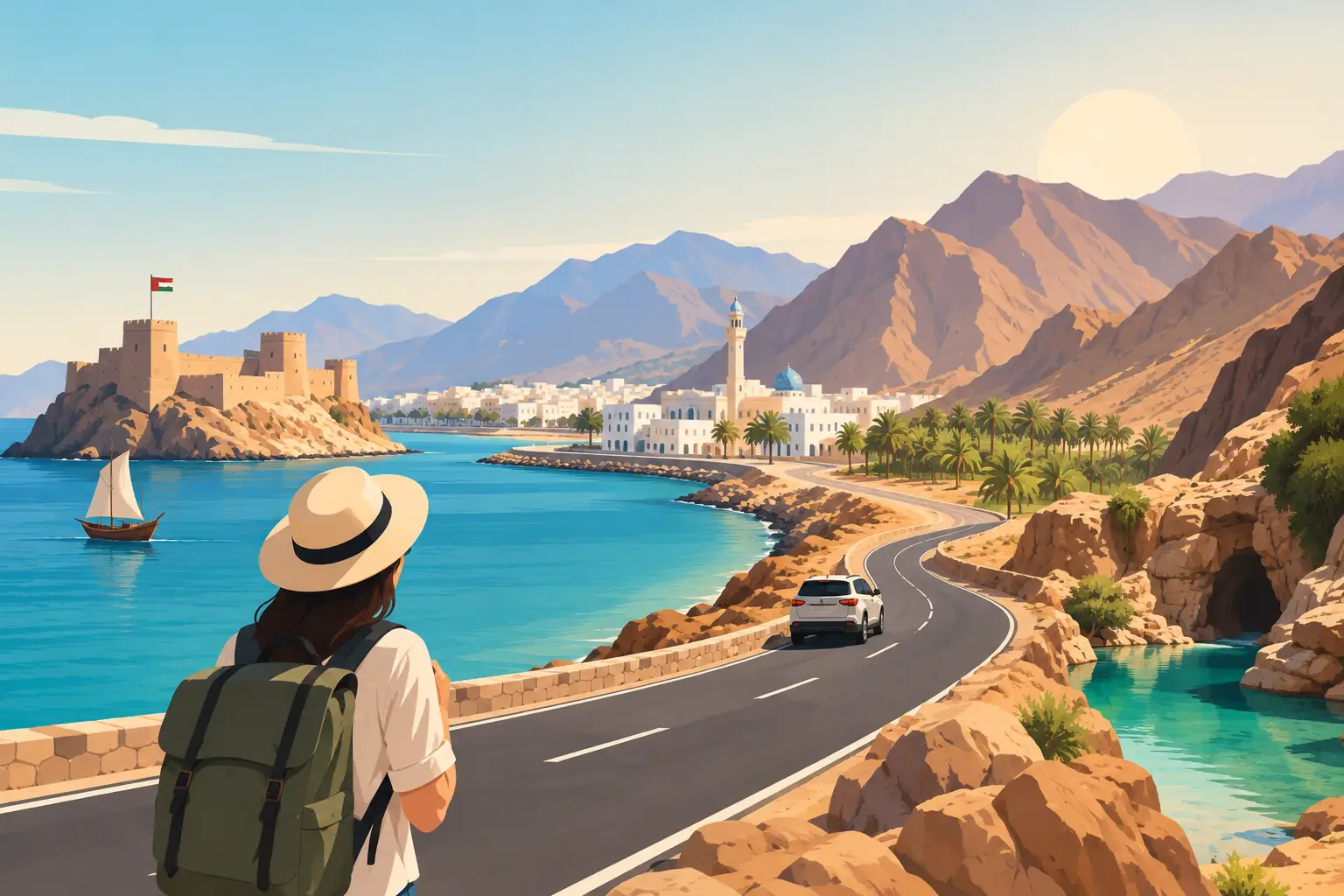
Three days in Oman can take you from incense-scented souqs and grand mosques to turquoise wadis, dramatic mountain roads, and dunes that turn copper at sunset. If you are deciding what to do in Oman for 3 days, resist the temptation to cross the entire country. Oman is larger, wilder, and more varied than it looks on a map. A well-paced route gives you real time to swim, walk, meet local people, and enjoy the landscape rather than spending every daylight hour in a vehicle.
For a first visit, the strongest choice is to combine Muscat with the interior around Nizwa and Jebel Akhdar, then finish in the Wahiba Sands. It is an active itinerary, but one that brings together Oman’s defining experiences: heritage, mountains, oasis villages, and a desert night.
Day 1: Muscat’s culture, coast, and evening atmosphere
Start your Oman trip in Muscat, a capital shaped by the Hajar Mountains on one side and the Gulf of Oman on the other. The city is spread out, so planning transport in advance makes a genuine difference. A private driver or guided day trip avoids wasted time between neighborhoods and lets you focus on the places that make Muscat memorable.
Begin at the Sultan Qaboos Grand Mosque, one of the country’s essential cultural visits. Non-Muslim visitors are welcome during designated morning hours, but modest clothing is required: shoulders, arms, and legs should be covered, and women need a headscarf. Arrive early for calmer light across the marble courtyards and more space to appreciate the prayer hall’s enormous chandelier and hand-woven carpet.
From there, continue to Mutrah, Muscat’s historic waterfront district. The Mutrah Corniche is ideal for a relaxed walk, with fishing boats, whitewashed buildings, and rugged mountains framing the harbor. Inside Mutrah Souq, browse frankincense, silver jewelry, pashminas, spices, and small Omani crafts. Bargaining is expected in some stalls, though a friendly approach goes much further than hard negotiation.
In the afternoon, drive through Old Muscat to see the ceremonial Al Alam Palace from outside, flanked by the Portuguese-era forts of Al Jalali and Al Mirani. The museums in this area are worthwhile if history is a priority, but do not try to fit every museum into a short stay. For many travelers, a sunset cruise from the marina is a better use of the late afternoon. Dolphins are sometimes spotted offshore, while the coastline looks especially striking from the water as the heat softens.
Spend the night in Muscat if you arrive late or prefer a slower start. If your flight arrives early and you are ready for an active schedule, you can also depart for Nizwa in the late afternoon and stay there, saving time on Day 2.
Day 2: Nizwa, mountain villages, and Jebel Akhdar
The second day is for the Oman of forts, date palms, and high mountain air. Leave Muscat early for Nizwa, around 90 minutes to two hours by road depending on traffic and your starting point. Nizwa was once the country’s political and religious center, and its fort remains one of the best places to understand Oman’s defensive architecture.
Walk the broad ramparts of Nizwa Fort, where views open across the old town and the surrounding date plantations. The fort’s displays reveal clever defensive systems, hidden wells, and the everyday life of a historic Omani stronghold. Next door, the traditional souq is a good stop for dates, halwa, pottery, and khanjars, the curved ceremonial daggers that are a powerful symbol of Omani identity. Friday’s livestock market is especially lively, but it is only worth building into your plan if your travel dates align.
After Nizwa, the route climbs toward Jebel Akhdar, the Green Mountain. A 4WD vehicle is required for the ascent, and it is not a road to treat casually. The mountain is cooler than the coast, especially between November and March, and its terraced farms create a surprising contrast with the surrounding rocky landscape.
At Al Ayn or nearby mountain villages, stone houses sit above deep ravines and cultivated terraces. In spring, the region is known for roses; at other times of year, pomegranates, walnuts, and olive trees still lend the slopes a softer texture. Walk a section of the village trails if conditions permit, but choose the route according to your fitness, footwear, and available daylight. Some paths are gentle, while others involve exposed edges and uneven stone steps.
Stay overnight in a mountain hotel, a village guesthouse, or a carefully organized camp. This is the day to slow down at sunset. As the light changes, the canyon walls become amber and the evening temperature drops quickly. Bring a light jacket even when Muscat has felt hot.
Day 3: Wahiba Sands and a desert night worth the drive
For travelers asking what to do in Oman for 3 days, a night in the Wahiba Sands is often the experience that stays with them longest. The route from the Nizwa area to the desert takes several hours, so leave after breakfast and allow time for stops rather than racing across the interior.
The Wahiba Sands, also called Sharqiya Sands, are not a single empty expanse. They are a living desert of tall dunes, Bedouin traditions, camels, desert shrubs, and shifting tracks. At the edge of the sands, transfer into a suitable 4WD with an experienced desert driver. Self-driving can be rewarding for confident travelers with proper equipment, but dune driving is not the place to learn. Sand conditions change, visibility can be limited, and GPS alone is not enough to navigate safely.
A desert program can be as relaxed or adventurous as you wish. Climb a dune for a wide view over the ridges, try sandboarding, ride a camel for a short introduction to traditional travel, or simply settle into camp with Arabic coffee and dates. The best moment is sunset, when the sand moves through shades of gold, orange, and red before the temperature falls.
Dinner at a desert camp is usually a social, unhurried affair. After dark, step beyond the camp lights and look up. The desert sky is one of Oman’s quiet luxuries, particularly on clear nights away from the moon. Choose a camp with proper bedding and private facilities if comfort matters, or opt for a more remote setup if you want a true adventure atmosphere.
If your international flight leaves the following day, organize an early 4WD exit and road transfer back to Muscat. The drive is typically around two and a half to three hours from the desert access points, depending on the camp location and traffic.
Prefer wadis and the coast? Make one smart swap
Not every traveler wants mountains and desert in the same short trip. If swimming, snorkeling, and coastal scenery are higher on your list, replace Jebel Akhdar and Wahiba Sands with the road to Wadi Shab and Sur. From Muscat, stop at the Bimmah Sinkhole, then take the short boat crossing and hike into Wadi Shab. The final swimming section and cave are spectacular, but the route involves rocks, water, and heat. Water shoes, dry bags, and confident swimming ability are useful.
Continue to Sur for a night near the coast, with time to see the traditional dhow-building heritage. Depending on the season, Ras Al Jinz can offer guided turtle-viewing excursions after dark. Wildlife sightings are never guaranteed, and that uncertainty is part of a responsible nature experience.
This coastal alternative is less focused on forts and high mountains, but it is ideal for active travelers, families with older children, and visitors who dream of Oman’s clear water as much as its dunes.
Make three days feel easy, not rushed
Oman rewards good logistics. Distances are manageable, but the country’s best roads lead into mountains, wadis, and desert areas where timing matters. Plan early starts, avoid driving unfamiliar mountain or desert roads after dark, and keep more drinking water than you think you will need. A 4WD is necessary for Jebel Akhdar and desert access, while many regular road routes can be done comfortably in a standard vehicle.
The best weather for this itinerary is generally from October through April. Summer brings intense heat at lower elevations, although the mountains remain more comfortable. Respect local customs in villages, mosques, and public places, and wear modest clothing outside resort settings.
A local team such as Majan Views Tourism can arrange the 4WD, licensed Omani guide, transfers, hotels, and desert camp as one connected route. That leaves you free to watch the landscape change through the window instead of managing checkpoints, road conditions, and arrival times.
Three days will not show you every side of Oman, and that is exactly why the journey works. Choose the route that matches your travel style, leave room for a sunset or an unplanned cup of kahwa, and let Oman give you a reason to return.

Comment (0)